



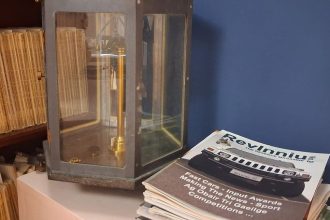


The Royal Society of Antiquaries of Ireland (RSAI) on Merrion Square has become an unusual canvas for artistic expression, thanks to “Only Handle It Once,” an exhibition by artists Cillian Finnerty and Cóilín O’Connell. The reception room, typically reserved for historical displays, is now adorned with pale pink plinths of various shapes—some act as ramps while others resemble steps. Each plinth showcases an eclectic array of items, from old pound coins on newspapers to whimsical trinkets shaped like aquatic creatures, alongside publications targeting metal detector enthusiasts.
As visitors navigate the space, they might stumble upon stacks of newspapers, including The Sun and The Racing Post, or glance at shelves lined with journals like The Pennsylvania Magazine of History and Biography. O’Connell, inspecting an abandoned sunburst comb tucked behind the bookshelves, humorously noted, “That’s just a comb,” reminding us of the everyday items that often get overlooked amid more significant artifacts.
This latest installation is part of the duo’s ongoing project titled Permanent Mirage. With roots tracing back to a show in Amsterdam in 2024, it taps into nuanced interpretations of the words “hoard” and “cache.” Finnerty elaborates on this distinction, suggesting that organization often defines a collection. “If somebody has a thousand stamps, that’s a collection,” he said, contrasting it with the disorganized accumulations of a hoarder.
However, the exhibition delves deeper into the nuances of value and the often-overlooked treasures we hoard. The artists explore why certain objects lose significance when stored away, unlike those that appreciate over time. O’Connell and Finnerty’s work emphasizes the intriguing contrasts in the value of hoarded items, particularly regarding data and archives.
One striking feature of the exhibit is a box of Revenue-branded floppy disks, whose valuable data is virtually inaccessible today. “There’s a handful of computers in the country that can read them,” Finnerty remarked, highlighting the irony of how our past tech holds untold stories that we can no longer access. Furthermore, their book, sharing the exhibition’s name, offers a glimpse into the Revenue Museum’s archives, containing objects once integral to the state’s narrative but now shrouded in mystery.
Amid the fascinating but often chaotic collection, one object stands out—a finely tuned weighing scale, used to determine the authenticity of materials for tax assessments. Finnerty’s description of it as an “atmospheric reader” that differentiates between the real and the fake underscores the exhibition’s thematic intricacies.
In our view, it’s refreshing to see an artistic approach to what could be deemed mundane. It’s almost comical how easily we dismiss items as mere clutter while being surrounded by so many hidden tales. This exhibition challenges our perceptions not just of art but of the stories tied to our belongings. Could this be essential viewing for those who proudly hoard boxes of old magazines and trinkets, convinced they’ll one day find a use for them? We think so.
Did you know? The concept of hoarding has gained attention for its psychological implications, with some studies suggesting it could be tied to attachment issues or past traumas. It makes you think twice about those mysterious boxes in your attic, doesn’t it?


